Pendant Lights and Chandeliers: Getting Statement Lighting Right in Perth Homes
A statement pendant or chandelier can transform a kitchen, dining room or lounge, but only when it is chosen, positioned and installed properly. In Perth, every hardwired light fitting must be connected by a licensed electrician, and heavier crystal fittings often need extra ceiling support before they go up. Here is what to know about hanging height, ceiling strength, dimming and choosing the right fitting, so your feature light looks as good at home as it did in the showroom.
What counts as statement lighting?
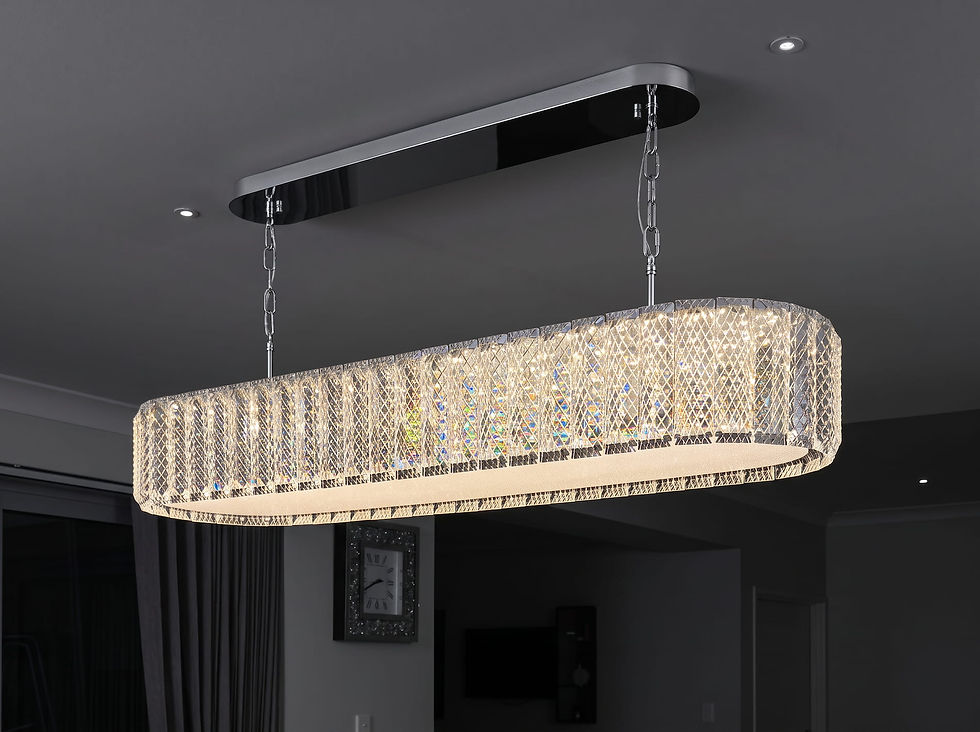
Statement lighting is any fitting chosen to be looked at, not just to light the room. Think tiered crystal ceiling lights in a formal lounge, long linear pendants running the length of a kitchen island, chandeliers over a dining table, and dramatic drops in double-height entries and voids.
Feature lighting suits almost any Perth home, from new builds with high ceilings in Alkimos, Butler, Yanchep and Clarkson to renovated family homes in Karrinyup, Carine, Duncraig and Hillarys. Done well, a statement light becomes the focal point of the room. Done poorly, it hangs too low, sags off the ceiling or clashes with the downlights around it. The difference is almost always in the planning.
How high should a pendant hang over a kitchen island?
As a general guide, the bottom of a pendant over a kitchen island should sit around 700 to 900mm above the benchtop. That height lights the bench properly, keeps the view across the kitchen open, and leaves room to work without the fitting getting in the way. Measure from the finished benchtop, not the floor.
Long islands suit a linear pendant rather than one small fitting, because a single long fitting spreads light evenly along the whole bench. A simple trick is to hold a piece of cardboard at the planned height before installation day to check your sightlines. Most pendants hang on chain or cable that is shortened during installation, so settle the final height with your electrician before anything is trimmed. On higher ceilings, the scale of the fitting and the proportions of the room come into play, which makes that conversation even more worthwhile.

Can my ceiling hold a heavy crystal chandelier?
Not always, and this is the question most people forget to ask. Plasterboard is not designed to carry a heavy fitting on its own. The strength comes from the timber ceiling joists behind it. Crystal fittings in particular can be surprisingly heavy, so check the weight on the product specifications before you buy.
If the light point does not line up with a joist, a licensed electrician will add proper support, usually a timber noggin fixed between the joists, so the fitting is anchored to the structure rather than the plaster. Bulkheads and raised ceiling sections need the same check, since what sits behind them varies from home to home. Getting this right is what stops a beautiful fitting from sagging, cracking the ceiling, or worse.
Do I need an electrician to install a pendant light in Perth?
Yes. In Western Australia, connecting a light fitting to your fixed wiring must be done by a licensed electrician, and that includes swapping an old fitting for a new pendant on an existing light point. DIY light installation is illegal, can void your home insurance, and is a genuine risk with heavy fittings hanging over the spaces where your family gathers.
A licensed installation covers the details that matter. The weight is carried by the mounting hardware rather than the electrical cable, the connection is made to the current AS/NZS 3000 wiring standard, and the circuit is tested before handover. Whether it is a single pendant in Scarborough or a full lighting upgrade in Joondalup, the same standard applies.

Should my statement light be dimmable?
For most feature lights, yes. Dimming lets one fitting work hard as task lighting over a kitchen bench, then soften into ambient light for dinner. The catch is compatibility. Not every LED fitting is dimmable, and dimmable fittings need an LED-compatible dimmer matched to them, otherwise you can get flickering, buzzing or a light that will not dim smoothly.
Colour temperature matters too. A cool white chandelier surrounded by warm white downlights can look mismatched, so it pays to plan the whole room together. Many modern fittings offer switchable colour temperature, which makes matching easier. A licensed electrician can confirm the fitting and dimmer are a proper pair before anything goes up.
What should I check before buying a feature light?
Before you commit, check the weight, the overall size and drop, and whether the ceiling canopy is large enough to cover the existing light point. Confirm whether the fitting is dimmable, what colour temperature it runs at, and that it carries the RCM mark, which shows it meets Australian electrical safety requirements. Lights bought cheaply from overseas websites do not always carry it, and an electrician may be unable to connect a fitting that is not compliant.
If you are unsure, send your electrician the product link before you buy. It takes a few minutes and can save you from a fitting that simply will not suit your ceiling.
Get your statement lighting installed properly
A feature light is an investment in how your home looks and feels every day, so it deserves an installation to match. Wiser Electrical Services is a licensed Perth electrical contractor (EC 16847) providing residential and commercial electrical work across the Perth metro area.
From pendant, chandelier and feature lighting installation to full lighting upgrades, we look after homes in Joondalup, Wanneroo, Stirling, Trigg, Sorrento, Kingsley, Woodvale, Landsdale, Doubleview, Churchlands and the surrounding suburbs. Request a call back or phone 0422 766 960 to talk through the statement lighting for your Perth home.


Comments